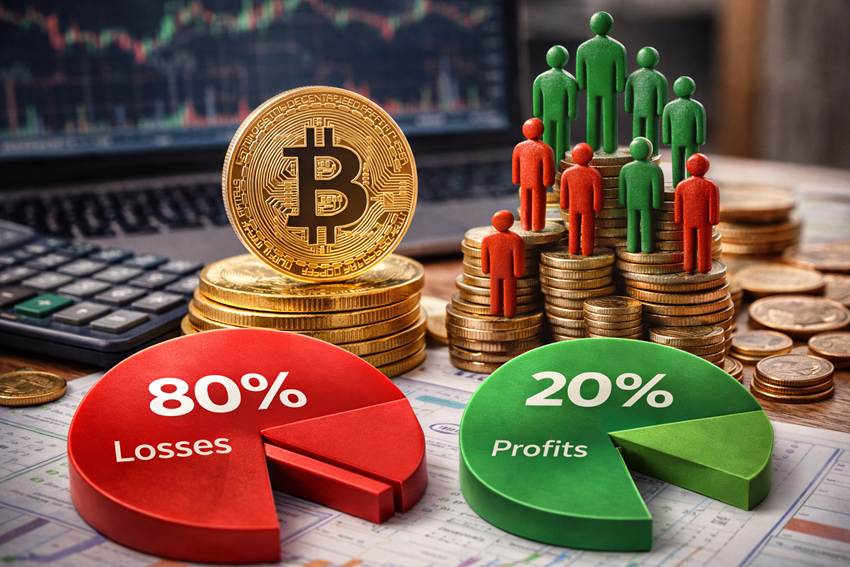
What Percent Of Crypto Traders Are Profitable? Breaking Down the Real Numbers
Data offers a clearer picture than marketing claims when assessing what percent of crypto traders are profitable.
Despite record participation and nonstop trading activity, consistent profits remain concentrated among a small group of traders. Most participants experience uneven results, short-term wins followed by deeper losses, or exit the market altogether.
Profitability in crypto trading is shaped by market cycles, execution discipline, and how traders manage risk during volatility.
Public exchange insights, academic research, and platform studies all point to the same conclusion. Success rates are far lower than many expect.
This article reviews those findings, breaks down profitability by trader behavior and market phase, and explains why long-term success in crypto trading remains difficult even in highly liquid markets.
Estimated Profitability Rates in Crypto Trading
Reliable industry data shows that a minority of cryptocurrency traders achieve consistent profits over years. A range of studies and platform insights generally cluster around a similar result.
| Source / Study | Estimated Profitability (%) | Notes |
|---|---|---|
| Exchange Surveys | 10-20% | Based on large-scale observations of active traders |
| BYDFi Estimate | ~15% | Traders with disciplined technical and risk skills |
| Binance Report | 5% | Broader narrative that many lose money |
| Day Trading Parallel Data | ~10% | Similar success rates in active short-term trading |
The pattern across multiple sources suggests that roughly 10% to 20% of crypto traders can be consistently profitable over a meaningful time frame. These numbers align with broader financial trading patterns, where a small portion of participants generate most of the net gains.
Profitability Across Trader Types
Trader profitability differs significantly depending on trading style, risk tolerance, and time horizon. Crypto markets offer a variety of ways to participate, such as long-term holding, day trading, leveraged positions, and algorithmic approaches.
| Trader Type | Approx. Profitability | Key Risk Factors |
|---|---|---|
| Long-Term (“HODL”) | 20-30% hold gains in bull markets | Large drawdowns possible |
| Active Day Traders | ~10-15% profitable | High fees + volatile moves |
| Algorithmic/Quant Traders | Variable | Depends on technology & model |
| Prop/Challenge Traders | ~5-10% pass evaluations | Structured but competitive |
Data specific to crypto is limited, but similar patterns appear across active trading communities and exchange research. Active traders face high fees, frequent losses, and emotional pressure, which pushes the profitability rate down. Those who use disciplined strategies and risk frameworks often perform better in the long term.
Profitability Trends by Experience and Strategy
Skill and experience play a major role in outcomes. Traders who use structured analysis and a disciplined plan generally fare better than those taking random or emotional trades.
| Experience Level | Profitable Traders (%) | Notes |
|---|---|---|
| Beginners | < 5% | Most lack risk control and clear plans |
| Intermediate | ~10-15% | Consistent risk management helps |
| Advanced/Pro | ~25%+ | Strong discipline and tools |
Beginners often enter crypto trading with little preparation and may overtrade or ignore risk controls. More experienced traders tend to manage position sizing, use stop rules, and follow tested strategies. While the exact numbers vary, profitability generally increases with skill and discipline.
Notably, data from traditional day trading research shows that a small share of traders with winning records still leave money on the table due to poor risk-reward management.
A study found that a large proportion of traders can have a win rate above 50%, yet many still lose money because losing trades tend to be larger than winning ones. This pattern likely holds in crypto due to similar trading behaviors.
Market Conditions and Profitability
Crypto markets go through cycles of expansion and contraction. Bullish trends create richer opportunities for profit, while bear markets shrink winning chances and increase losses.
| Market Phase | Profitability Outlook | Typical Trader Impact |
|---|---|---|
| Bullish | Higher | More traders see gains |
| Sideways | Moderate | Range strategies matter |
| Bearish | Lower | Higher losses, more churn |
Profitability in crypto trading is not static. During extended price rises, more traders can be profitable as overall prices trend upward. Conversely, in bear markets, volatility can wipe out unprepared positions quickly. Traders who adapt to conditions and adjust risk thresholds tend to have better outcomes over full cycles.
Tools and Data for Assessing Trading Performance
Understanding profitability is not just about raw percentages. Tools that analyse performance help traders refine strategies.
For instance, crypto traders might use LambdaFin’s Stock Screener to study broader market trends and compare crypto sentiment with related equities. A Backtester can simulate how a specific strategy might have performed in past crypto price cycles. These tools help traders build evidence-based plans rather than relying on intuition alone.
A disciplined approach to analyzing past returns, adjusting for fees, and tracking win/loss ratios is key to improving trading outcomes. Traders who track metrics like average gain per trade and drawdown frequency tend to make more informed decisions.
Pitfalls and Cautions on Profitability Numbers
While data suggests only a fraction of traders are profitable, there are some important nuances:
- Exchange data varies by platform because each exchange has different user bases and trading conditions.
- Self-reported profitability numbers can be skewed by survivor bias, as only active or successful traders may publish results.
- Some sources suggest that social media spreads a “90% lose money” narrative, but broad real data points more reliably to ~10%-20% consistency.
Conclusion
Looking at what percent of crypto traders are profitable helps bring expectations back to a realistic level. Crypto markets attract a lot of participation, but steady success is rare. Outcomes depend on how traders react to market swings, how they manage risk, and how consistent their approach is over time.
Trading crypto is not easy. Many people enter during strong moves and struggle when conditions change. Those who take the time to study past behavior, review their own decisions, and adjust as the market shifts tend to last longer.
LambdaFin gives traders a place to step back, review patterns, and think more clearly about performance instead of reacting to every price move.
There is no single rule that guarantees results. Progress usually comes from patience, awareness, and a willingness to learn from mistakes rather than chasing quick wins.