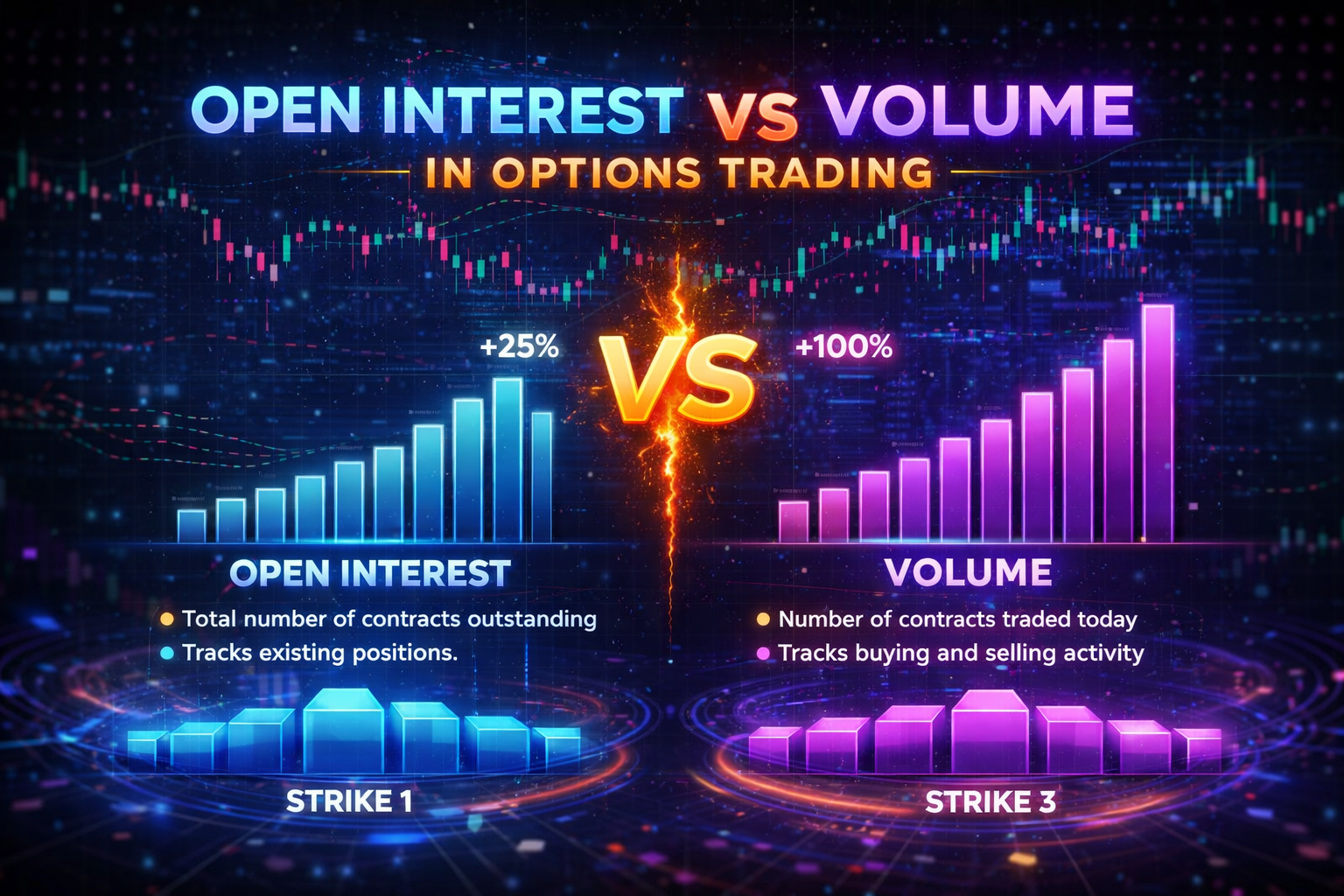
Open Interest vs Volume in Options Trading: How to Read Both and What They Signal (2025)
Lambda Finance compiled open interest vs volume in options trading data from CBOE market statistics, academic research from the Auckland Centre for Financial Research, Interactive Brokers educational resources, and options analytics platforms covering 2024 through 2025. This report addresses three search intents: what each metric measures and how they differ, how to interpret the four signal combinations (price direction + open interest change), and what liquidity thresholds matter for practical trade execution. Open interest measures the total number of active contracts outstanding, while volume measures how many contracts traded during a session. Together they form a three-dimensional view of market activity: price shows direction, volume shows intensity, and open interest shows conviction. The tables below quantify every dimension of the open interest vs volume comparison with real market data.
1. Open Interest vs Volume: Core Differences
The table below defines the fundamental differences between open interest and volume in options trading across eight key dimensions.
| Dimension | Volume | Open Interest |
|---|---|---|
| Definition | Number of contracts traded during a session | Total active contracts outstanding at end of day |
| Resets? | Yes — resets to 0 each day | No — cumulative, rolls forward |
| When updated | Real-time throughout trading day | Once per day (after market close, reported next morning) |
| What it measures | Activity and interest today | Market commitment and total positioning |
| Can volume exceed OI? | Yes | N/A |
| Liquidity signal | High volume = easier fills today | High OI = tighter spreads, better ongoing liquidity |
| Sentiment signal | Intensity of interest at a specific strike/expiry | Conviction — are traders committing capital or exiting? |
| Key question it answers | “How active is this contract right now?” | “How many traders are still holding positions?” |
The most important distinction: volume can exceed open interest because the same contract can trade multiple times in a single day. If 10,000 contracts trade but only 2,000 represent new positions (the rest are existing holders selling to new buyers), volume is 10,000 but open interest only increases by 2,000. This is why volume alone does not tell you whether new money is entering the market or existing participants are reshuffling positions.
2. The Four-Signal Grid: Price + Open Interest
The most actionable way to use open interest vs volume in options trading is the four-signal grid. This framework combines price direction with changes in open interest to classify market activity into four distinct scenarios.
| Scenario | Price | Open Interest | Signal | Strength | Interpretation |
|---|---|---|---|---|---|
| Long Buildup | ↑ Rising | ↑ Rising | BULLISH | Strong | New buyers entering; fresh capital supports the move. Trend likely to continue. |
| Short Buildup | ↓ Falling | ↑ Rising | BEARISH | Strong | New sellers entering; fresh short positions being established. Downtrend likely to persist. |
| Short Covering | ↑ Rising | ↓ Falling | WEAK BULL | Weak | Shorts closing positions, pushing price up. Rally may be temporary—no new buying conviction. |
| Long Unwinding | ↓ Falling | ↓ Falling | WEAK BEAR | Weak | Longs closing positions, causing price decline. Selling pressure may exhaust soon. |
The key insight from the four-signal grid: open interest change tells you whether a price move is driven by new money entering the market (strong signal) or existing positions being closed (weak signal). A rally on rising open interest (long buildup) is far more sustainable than a rally on falling open interest (short covering), because the first has fresh capital behind it while the second is merely short sellers exiting. Academic research from the Auckland Centre for Financial Research confirms that portfolios constructed from OI-based signals have generated raw returns exceeding 60% annually in backtested environments.
Signal Strength: Open Interest + Price Direction
| Long Buildup |
Strong Bullish — New buyers, price rising
|
| Short Buildup |
Strong Bearish — New sellers, price falling
|
| Short Covering |
Weak Bull — Shorts exiting
|
| Long Unwinding |
Weak Bear — Longs exiting
|
Chart: Lambda Finance | Framework: CBOE, Interactive Brokers
3. How Open Interest and Volume Change Together
Understanding how open interest changes requires knowing what happens when different types of traders interact. The table below shows the six possible transaction scenarios and their effect on both metrics.
| Buyer | Seller | Volume Effect | OI Effect | What Happened |
|---|---|---|---|---|
| New buyer (opening) | New seller (opening) | +1 | +1 | New contract created. Both sides open new positions. |
| Existing holder (closing) | Existing holder (closing) | +1 | -1 | Contract destroyed. Both sides close existing positions. |
| New buyer (opening) | Existing holder (closing) | +1 | 0 | Contract transferred. One exits, one enters—net zero OI change. |
| Existing holder (closing) | New seller (opening) | +1 | 0 | Contract transferred. Positions change hands—no new contract. |
This is the mechanical reason volume can exceed open interest: every transaction adds to volume regardless of whether it creates, transfers, or destroys a contract. Only the first scenario (new buyer + new seller) increases open interest. Only the second (both sides closing) decreases it. The transfer scenarios (rows 3 and 4) add volume but leave open interest unchanged. This means a contract with 500 open interest can see 5,000 contracts of daily volume if those 500 contracts change hands multiple times.
4. Liquidity Thresholds: Minimum Volume and Open Interest for Trading
One of the most practical applications of open interest vs volume in options trading is assessing whether a specific contract has enough liquidity to trade efficiently. The table below provides threshold guidelines.
| Liquidity Level | Open Interest | Daily Volume | Typical Bid-Ask Spread | Suitability |
|---|---|---|---|---|
| Illiquid | < 100 | < 50 | $0.20–$1.00+ | AVOID |
| Low Liquidity | 100–500 | 50–200 | $0.10–$0.30 | CAUTION |
| Adequate | 500–5,000 | 200–1,000 | $0.03–$0.10 | GOOD |
| Highly Liquid | 5,000+ | 1,000+ | $0.01–$0.05 | OPTIMAL |
Options Liquidity Scale: Open Interest Thresholds
| Optimal |
5,000+ OI — $0.01–$0.05 spread
|
| Good |
500–5,000 OI — $0.03–$0.10 spread
|
| Caution |
100–500 OI
|
| Avoid |
<100 OI
|
Chart: Lambda Finance | Thresholds from TradingBlock, SoFi, Lightspeed
Contracts with open interest below 100 should generally be avoided—the bid-ask spread often exceeds $0.20, meaning you pay 10–20% or more of the option’s value just to enter and exit. For contracts in the $1–$5 range, this spread cost can destroy profitability. The minimum practical threshold for most strategies is 500 OI, where spreads tighten to $0.03–$0.10. SPY and QQQ options routinely show open interest in the tens of thousands with penny-wide spreads, which is why they are the most popular underlyings for options strategies.
5. Volume-to-Open Interest Ratio: Detecting Unusual Activity
The volume-to-OI ratio is a secondary signal that can identify unusual options activity. When daily volume significantly exceeds open interest, it suggests abnormal interest in that specific contract—often ahead of earnings, FDA decisions, or other catalysts.
| Volume / OI Ratio | Interpretation | Typical Cause | Actionability |
|---|---|---|---|
| 0.0–0.3 | Low activity | Normal daily trading in established positions | No signal |
| 0.3–1.0 | Normal activity | Healthy mix of new and closing trades | No signal |
| 1.0–3.0 | Elevated interest | Potential institutional positioning; pre-event activity | WATCH |
| 3.0+ | Unusual activity | Large block trades, sweep orders, potential insider/institutional flow | INVESTIGATE |
A volume-to-OI ratio above 3.0 means daily volume exceeded three times the total existing positions—a level that rarely occurs without a specific catalyst. Research shows that stocks with unusual options activity are five times more likely to see major price changes within days. However, not all unusual activity is predictive: institutions use options for hedging, rebalancing, and tax-loss harvesting, none of which predict directional moves. The signal is most reliable when accompanied by aggressive pricing (buying at the ask rather than the bid) and concentrated in short-dated, out-of-the-money contracts.
6. U.S. Options Market: Volume and Open Interest Scale (2024–2025)
To provide context for interpreting open interest vs volume in options trading, the table below shows the current scale of the U.S. options market.
| Metric | 2024 | 2025 | YoY Change |
|---|---|---|---|
| Total annual contracts traded | 12.1 B | 15.2 B | +26% |
| Average daily volume (all exchanges) | ~48 M | ~59 M | +22% |
| SPX Index options ADV | ~3.2 M | 3.8 M (Q3 record) | +19% |
| 0DTE share of SPX volume | ~51% | 57% | +6 pp |
| Days exceeding 70M contracts | — | 21 days (5 exceeded 80M) | — |
| Consecutive annual volume records | 6 years (2020–2025) | ||
U.S. options volume has set records for six consecutive years, reaching 15.2 billion contracts in 2025—a 26% increase over 2024. The growth in volume outpaces growth in open interest, meaning more contracts are being opened and closed within shorter timeframes (particularly 0DTE options, which now represent 57% of SPX volume). This trend makes the open interest vs volume distinction more important than ever: with 0DTE contracts, open interest is nearly irrelevant because positions are opened and closed within hours, but volume spikes remain meaningful as activity indicators.
7. Key Takeaways
- Volume measures today’s activity; open interest measures total positioning. Volume resets daily; open interest is cumulative and only changes when new contracts are created or existing ones destroyed.
- The four-signal grid is the core framework. Rising price + rising OI = strong bullish (long buildup). Falling price + rising OI = strong bearish (short buildup). The other two combinations (short covering, long unwinding) are weak signals indicating position exits rather than new conviction.
- Volume can exceed open interest. A contract traded multiple times in one day adds to volume each time but may not change OI at all. This is why volume alone cannot tell you if new money is entering.
- Minimum OI threshold for trading: 500. Below 500, bid-ask spreads typically exceed $0.10, creating significant hidden costs. Below 100, spreads can exceed $0.20–$1.00.
- Volume-to-OI ratio above 3.0 signals unusual activity. Stocks with unusual options activity are 5x more likely to see large price moves, but most UOA signals are noise from hedging and rebalancing.
- 0DTE options make OI less relevant for short-dated trading. With 57% of SPX volume now in 0DTE contracts, open interest is primarily useful for contracts with 7+ DTE where positions are held overnight.
Methodology
This analysis uses market statistics from CBOE (daily volume, open interest reports, Q3 2025 State of the Options Industry), OCC clearing data, educational resources from Interactive Brokers Trading Academy and Option Alpha, academic research from the Auckland Centre for Financial Research on OI-based portfolio strategies, and options analytics data from Barchart and InsiderFinance. The four-signal grid follows the industry-standard framework used by CBOE, Interactive Brokers, and major options education platforms. Liquidity thresholds are derived from multiple platform guidelines and represent approximate ranges—actual spreads vary by underlying, moneyness, and expiration. All market size figures reflect U.S. listed equity and index options. Data compiled March 2026 by Lambda Finance.
Related Articles
- Best Indicator for Option Trading: Win Rates and Backtest Data
- Options Trading Rate of Return: What Traders Actually Earn
Sources
Exchange & Market Data
- CBOE — Daily Market Statistics — Daily volume, open interest, and put/call ratio data across all Cboe exchanges
- CBOE — State of the Options Industry: Q3 2025 — Record volume data, 0DTE growth, SPX ADV of 3.8M contracts
- Barchart — Options With Highest Change in Open Interest — Daily OI change screener for identifying unusual activity across all listed options
Educational Resources
- Interactive Brokers — Open Interest Trading Lesson — Mechanics of how OI changes with different transaction types and trading signals
- Option Alpha — Options Volume vs Open Interest — Visual guide to the four-signal grid and practical liquidity assessment
- Charles Schwab — Understanding Open Interest vs Volume — Core definitions, reset behavior, and bid-ask spread relationship
- projectfinance — Open Interest vs Volume Explained — Transaction-level examples showing how each trade type affects OI and volume
- TradingBlock — Options Trading Liquidity: Volume, Open Interest, Size & More — Liquidity threshold guidelines and bid-ask spread benchmarks by OI level
Academic & Analytical Research
- Auckland Centre for Financial Research — Why Does Option Open Interest Predict Stock Returns? — Academic study finding OI-based long-short portfolios yielding 60%+ annual raw returns
- Springer — Do Short-Lived Options Reveal Information Asymmetry? (2025) — Evidence from open interest and volume signals in short-dated options
- OptionsTrading.org — Using Open Interest to Predict Price Action — Practical application of OI-based signals with machine learning prediction enhancements