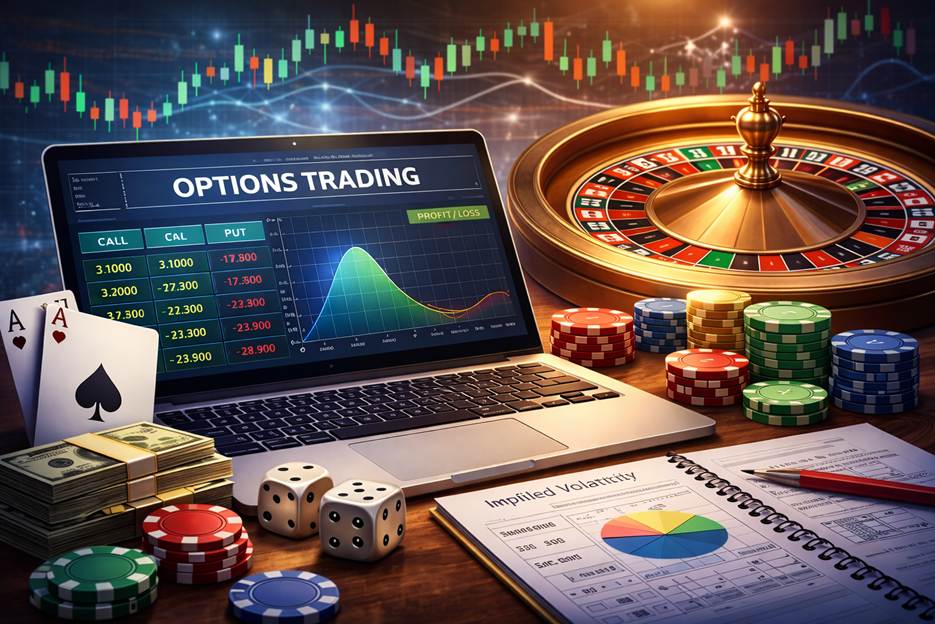
Is Option Trading Gambling? Risk, Structure, and Decision-Making Explained With Data
‘Is option trading gambling’ is a question that comes up whenever people see fast gains, sharp losses, or dramatic stories tied to options markets.
At first glance, options can look unpredictable. Prices move fast, outcomes feel uncertain, and losses can happen quickly. That surface view leads many to compare options to casino bets. In reality, the answer depends on how options are used, measured, and managed.
Options are financial contracts with defined rules, pricing models, and probabilities that can be analyzed in advance. The difference between gambling and structured trading often comes down to preparation, data, and risk control.
Let’s break down how options work, how outcomes are shaped, and where behavior determines the line between speculation and strategy.
How Option Trading Actually Works
Options give traders the right, but not the obligation, to buy or sell an asset at a set price before a certain date. There are two basic types: calls and puts. A call option benefits from price increases. A put option benefits from price declines.
Every option contract has four core components:
- Strike price
- Expiration date
- Premium paid or received
- Underlying asset price
These variables are not random. They are priced using volatility, time decay, interest rates, and supply and demand. Models such as Black-Scholes form the base for option pricing across global markets. While no model predicts the future perfectly, option prices reflect collective expectations, not chance alone.
This structure is what separates options from games of chance. The outcome is uncertain, but the framework is defined.
Why Option Trading Gets Compared to Gambling
The gambling comparison often comes from how options are used rather than what they are.
| Common Behavior | Why It Feels Like Gambling |
|---|---|
| Buying short-dated options | Low probability, high payoff outcomes |
| Ignoring volatility | Prices swing sharply without warning |
| Overleveraging | Small moves cause large losses |
| Trading without a plan | Decisions driven by emotion |
When traders buy weekly options hoping for fast gains, they are accepting low odds in exchange for excitement. That behavior mirrors gambling psychology. The instrument itself is not the problem. The approach is.
Probability and Expected Value in Options
One major difference between gambling and trading is the role of probability and expected value.
| Concept | In Gambling | In Options Trading |
|---|---|---|
| Odds | Fixed by the house | Implied by market pricing |
| Expected value | Usually negative | Can be positive or negative |
| Risk control | Limited | Adjustable |
| Position sizing | Fixed bets | Flexible |
Casinos design games so the expected value favors the house. Options markets do not have a built-in house edge. Prices adjust constantly based on demand, volatility, and time. Skilled traders aim to structure positions where probabilities and payouts align with their risk tolerance.
Understanding probability is critical here. Option traders often use probability of profit, breakeven levels, and scenario analysis before entering trades. These calculations help replace guesswork with measurable expectations.
What the Data Says About Option Trading Outcomes
Large data sets show that outcomes vary widely based on strategy and holding period.
| Trading Style | General Outcome Trend |
|---|---|
| Short-term option buying | Lower win rates |
| Option selling strategies | Higher win rates |
| Hedging with options | Risk reduction |
| Random entry trading | Negative expectancy |
Research shows that consistent option sellers often achieve higher win rates due to time decay working in their favor. This does not mean selling options is risk-free. Losses can still be large without controls. It does show that structure and probability matter.
Risk Is Not the Same as Gambling
Risk exists in all financial activity. Stocks, bonds, real estate, and even savings accounts carry risk. Gambling is defined by outcomes driven mainly by chance with no ability to influence probabilities over time.
Options allow traders to shape:
- Maximum loss
- Maximum gain
- Time exposure
- Directional bias
| Risk Element | Gambling | Options Trading |
|---|---|---|
| Loss control | None | Defined |
| Strategy adjustment | Not possible | Possible |
| Learning curve | Limited | Continuous |
| Data usage | Minimal | Central |
This flexibility is what makes options a financial tool rather than a game. Misuse turns it into speculation. Discipline turns it into strategy.
The Role of Volatility and Time
Two forces dominate option pricing: volatility and time decay.
Volatility reflects how much the market expects prices to move. Time decay represents how option value erodes as expiration approaches.
Traders who ignore these factors often feel blindsided. Those who plan around them gain clarity.
| Factor | Impact on Options |
|---|---|
| High volatility | Higher option premiums |
| Low volatility | Cheaper options |
| Short time to expiry | Faster value loss |
| Longer duration | Slower decay |
This is why experienced traders track earnings dates, economic releases, and volatility cycles. For example, investors often use an Options Calculator to model how option prices may react to price changes, volatility shifts, and time decay, helping ensure their exposure aligns with known risk scenarios rather than unexpected outcomes.
Behavior Is the Real Divider
The strongest argument in the option trading gambling debate often comes down to behavior rather than the instrument itself. Options respond to structure and discipline, but they punish impulse.
Traders who chase losses or enter positions based on emotion tend to experience unstable results. Oversized trades amplify mistakes, and the absence of exit rules leaves outcomes open to chance rather than planning.
In contrast, traders who approach options strategically focus on predefined exits and consistent position sizing. Their decisions are guided by rules instead of reactions. They review performance over time, adjust based on outcomes, and treat each trade as part of a broader process rather than a one-off event.
Two traders can use the same option contract and see very different results. One treats the position like a lottery ticket, hoping for a sudden payoff. The other treats it as a probability exercise, managing risk across scenarios and accepting outcomes as part of a longer decision cycle.
How Structured Traders Approach Options
Experienced traders focus less on predicting exact price moves and more on managing scenarios.
They ask:
- What happens if the stock moves up, down, or sideways?
- How much can I lose?
- How does time work for or against this position?
Many traders evaluate this using sensitivity analysis rather than simple profit targets. For example, a Greeks Calculator helps traders understand how an option responds to changes in price, time, and volatility before capital is committed. Seeing how delta and theta interact allows traders to anticipate risk exposure instead of reacting after a move occurs.
Similarly, understanding option sensitivity through measures like delta and theta helps traders see how positions respond to price changes and time. This reinforces the idea that options reward planning, not guessing.
Options as Risk Management Tools
Options were not originally designed for speculation. They were created to manage risk.
Farmers used them to lock in prices. Portfolio managers use them to hedge downside risk. Corporations use them to stabilize cash flows.
| Use Case | Purpose |
|---|---|
| Protective puts | Limit downside |
| Covered calls | Generate income |
| Spreads | Control exposure |
| Collars | Balance risk and reward |
When options are used this way, the gambling comparison breaks down quickly. These strategies aim to reduce uncertainty, not amplify it.
Conclusion
The line between gambling and trading is shaped by how choices are made.
Options can magnify mistakes when used as quick bets with no structure. They can also support disciplined strategies built on probability, defined risk, and planning. Markets tend to reward preparation and punish impulse.
Understanding pricing, volatility, and behavior helps move options away from speculation and toward informed decision-making.
As markets grow more complex, access to clear data and context matters more than ever. LambdaFin helps investors evaluate market activity and pricing dynamics in a structured way, supporting better judgment and keeping option trading grounded in analysis rather than chance.