Trust Signals in Small Business Diligence: A Quiet Reputation Risk in Investing
In financial research, credibility is usually quantified through audited statements, historical performance, and forward projections. But outside of balance sheets, one variable remains difficult to measure: whether a business is genuinely trusted in its market — or simply good at marketing itself.
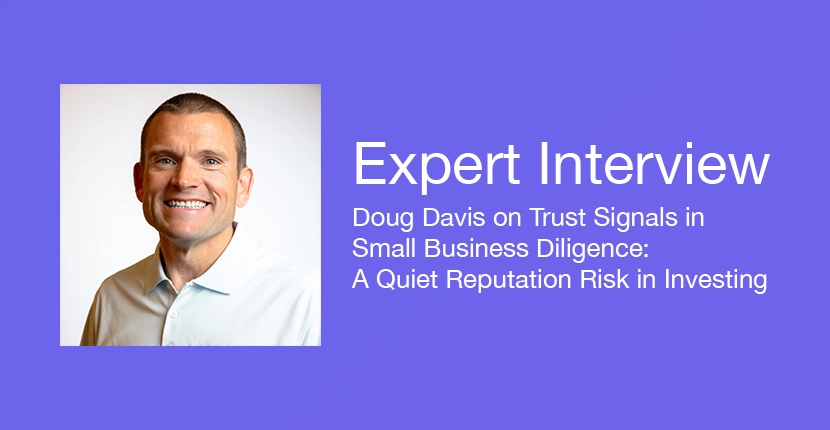
We spoke with Doug Davis, Founder of Voted Number One, the top-rated platform for community-voted local business awards focused on transparent, customer-validated rankings, about how investors should think about community recognition as a trust signal, and why the rise of purchased awards may distort market perception.

As “pay-to-win” awards have proliferated, a new reputational blind spot has emerged in small business evaluation. Some badges reflect real customer validation. Others reflect marketing budgets.
Joshua Weisberg: Doug, when investors evaluate businesses, they’re trained to filter out noise. Where do you think awards and badges fall in that conversation?
Doug Davis: Most awards function as noise because they don’t alter the fundamentals of a business. If recognition can be bought, it isn’t a quality signal — it’s a line item in the marketing budget.
Investors should ask whether the badge reflects measurable customer validation or simply reflects spend. That distinction matters more than most people realize.
Joshua Weisberg: What’s the real risk of a business using pay-to-win awards?
Doug Davis: The risk is misalignment between perception and reality.
If customers assume an award reflects merit, but it was purchased, the brand is borrowing credibility rather than earning it. When that gap becomes visible, trust can erode quickly — and erosion in trust can materially impact retention and referrals.
For investors, that introduces reputational fragility that may not appear in financial statements.
Joshua Weisberg: For someone doing diligence, what’s the difference between a real trust signal and a marketing badge?
Doug Davis: A real trust signal originates outside the business. It’s based on customer participation, transparent voting mechanisms, or publicly verifiable criteria.
A marketing badge, by contrast, is controlled or financed by the company itself. The more control a business has over its “recognition,” the less weight that signal should carry.
Joshua Weisberg: Investors care about retention, referrals, and pricing power. Do you see community recognition connecting to those outcomes?
Doug Davis: Indirectly, yes.
Community-driven recognition often reflects underlying customer loyalty, service consistency, and local goodwill. While recognition itself doesn’t create those strengths, it can serve as a proxy indicator that they exist.
In small and mid-sized businesses, those intangible assets frequently determine long-term durability.
Joshua Weisberg: What’s the most practical way an investor or advisor should interpret community voting?
Doug Davis: Treat it as a supporting validation point. It doesn’t replace financial diligence, but it can help confirm that a business has authentic standing within its customer base.
Like any data point, context matters. But ignoring customer-derived validation altogether leaves a blind spot.
Joshua Weisberg: Why do you think paid awards became so common?
Doug Davis: Because credibility is monetizable.
There’s strong demand from businesses that want quick validation, and for many award platforms, that demand translates into predictable revenue. The challenge is sustainability. Once consumers or investors recognize that recognition is transactional, the signal weakens.
Markets eventually discount artificial indicators.
Joshua Weisberg: Where do you see business recognition heading over the next few years?
Doug Davis: Toward transparency and verifiability.
The next phase of business recognition will favor platforms that can clearly demonstrate how winners are selected and how participation works. Opaque systems are increasingly viewed as liabilities, especially in investor-informed markets.