Diagonal Spread Options Strategy: Setup, PMCC Comparison, and Backtest Performance (2025)
Lambda Finance compiled diagonal spread options strategy data from Data Driven Options backtests, ORATS optimization studies, Option Alpha and tastytrade strategy research, and TradeStation educational materials. This report covers call and put diagonal spreads, the Poor Man’s Covered Call (PMCC) variant, capital efficiency comparisons against covered calls and calendar spreads, and rolling adjustment techniques. The diagonal spread options strategy combines elements of vertical and calendar spreads by using different strike prices and different expiration dates, producing a position that profits from time decay, directional movement, or both. Backtested configurations on SPX have generated annualized returns of 35–106% on capital deployed, depending on parameters. The tables below detail every dimension of this strategy with supporting data.
1. What Is the Diagonal Spread Options Strategy?
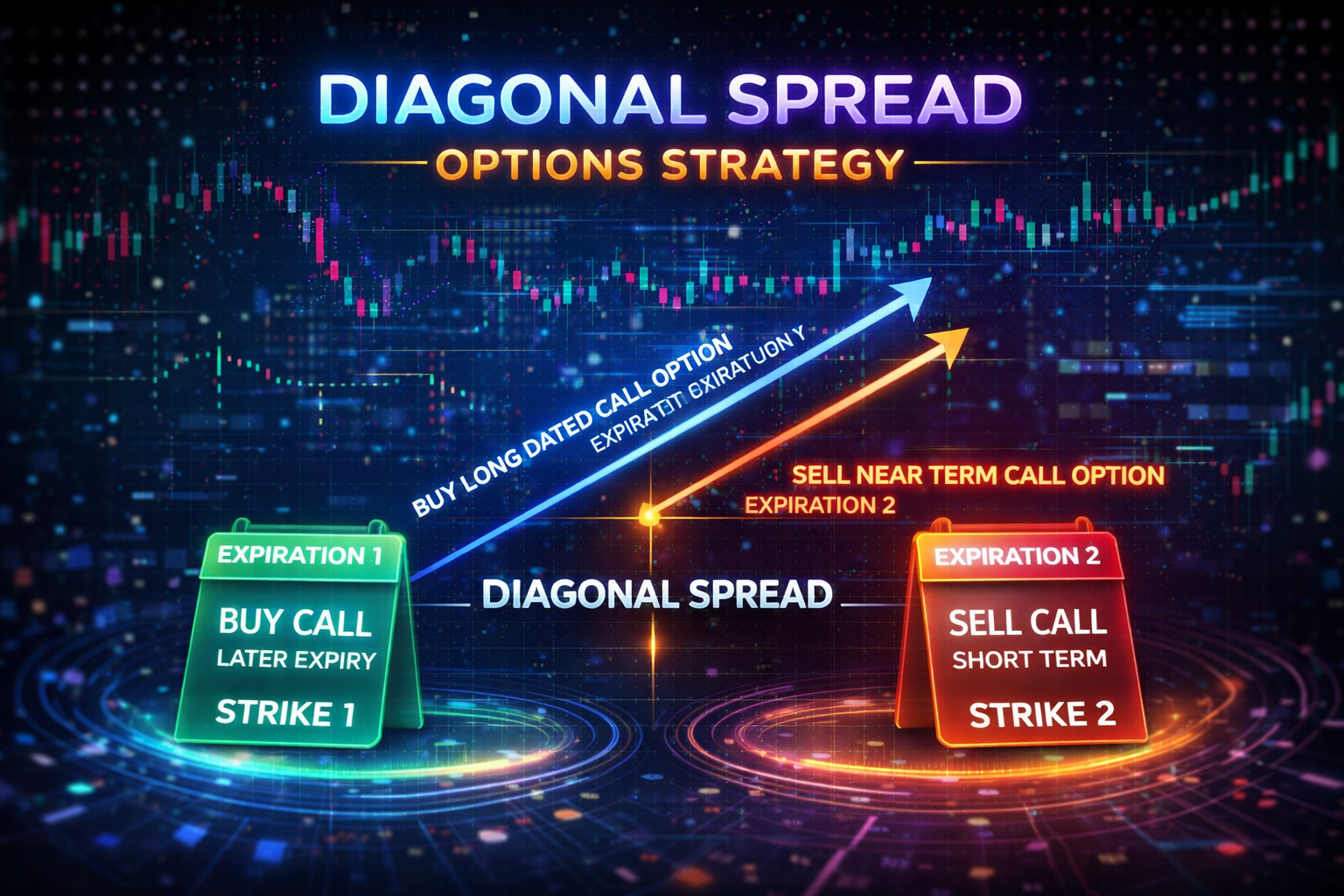
A diagonal spread options strategy combines a long option at one strike and expiration with a short option at a different strike and a nearer expiration. The table below defines the four primary variants.
| Variant | Long Leg | Short Leg | Bias | Common Name |
|---|---|---|---|---|
| Call Diagonal (bullish) | Buy ITM call, far-dated (60–365 DTE) | Sell OTM call, near-dated (21–45 DTE) | Bullish | Poor Man’s Covered Call (PMCC) |
| Put Diagonal (bearish) | Buy ITM put, far-dated (60–365 DTE) | Sell OTM put, near-dated (21–45 DTE) | Bearish | Poor Man’s Covered Put |
| Double Diagonal | Buy ITM call + ITM put, far-dated | Sell OTM call + OTM put, near-dated | Neutral | Double Diagonal |
| Short Diagonal | Buy OTM option, near-dated | Sell ITM option, far-dated | Directional | Reverse Diagonal |
The call diagonal (PMCC) is by far the most popular variant of the diagonal spread options strategy. It replicates a covered call position at a fraction of the capital cost by substituting stock ownership with a deep in-the-money LEAPS call option. The short call generates recurring income through time decay, while the long LEAPS provides directional exposure and serves as collateral.
2. Diagonal Spread vs Covered Call vs Calendar Spread
The diagonal spread options strategy is most commonly compared against covered calls and calendar spreads. The table below provides a direct comparison across the metrics that matter for strategy selection.
| Metric | Diagonal (PMCC) | Covered Call | Calendar Spread |
|---|---|---|---|
| Capital Required ($100 stock) | ~$1,500–$3,000 | $10,000 | ~$200–$500 |
| Capital Efficiency | 15–30% of covered call | 100% (full stock cost) | 2–5% of stock cost |
| Directional Exposure (Delta) | Moderate (0.50–0.80) | High (0.60–1.00) | Low (~0.05–0.15) |
| Theta Benefit | Yes (short leg decays faster) | Yes (short call decays) | Yes (primary driver) |
| Max Loss | Net debit paid | Stock price minus premium | Net debit paid |
| Leverage Effect | High (3–5x on % basis) | None (1:1) | Moderate |
| Monthly Income Potential | 2–3% on capital | 1–2% on capital | Variable |
| Downside Behavior | LEAPS bleeds faster than stock | Stock cushioned by premium | Limited to debit |
| Best For | Capital-efficient income + moderate bullish | Income on existing holdings | Neutral; IV expansion bets |
Capital Required: Diagonal (PMCC) vs Covered Call ($100 Stock)
| Covered Call |
$10,000 (100 shares)
|
| PMCC (deep ITM) |
$2,500
|
| Calendar Spread |
$350
|
Chart: Lambda Finance | Approximate capital for $100 stock
The diagonal spread options strategy requires approximately 15–30% of the capital needed for a covered call—$2,500 vs $10,000 for a $100 stock. This capital efficiency is the primary reason traders use diagonals: a 5% stock move generates 15–25% returns on a PMCC versus 5% on a covered call, because the percentage is calculated on a much smaller base. The trade-off is downside risk: during selloffs, the LEAPS call loses value from both falling prices and time decay, often faster than the stock itself would decline.
3. Diagonal Spread Backtest Performance
The table below compiles backtest results from multiple sources for the diagonal spread options strategy across different configurations.
| Configuration | Return on Capital | Win Rate | Max Drawdown | Source |
|---|---|---|---|---|
| Daily Diagonal Covered Put (SPX, 2024) | 106% annual | ~40% | -34% | Data Driven Options |
| Optimal Put Diagonal (Short 60d / Long 555d, 10δ/40δ) | Highest Sharpe | — | — | ORATS |
| PMCC (typical, 2–3% monthly target) | 24–36% annual | 65–75% | -20 to -40% | Practitioner consensus |
| CBOE BXM (covered call benchmark) | 7–10% annual | 75–85% | -11 to -25% | CBOE BXM Index |
| Daily Diagonal (2020–2024 avg) | ~35% annual | ~40% | -34% | Data Driven Options |
The Data Driven Options daily diagonal covered put generated 106% return on capital in 2024, with a beta of approximately one-third of an equivalent SPX position. However, the win rate was only ~40% (defined as closing above the last all-time high)—meaning the strategy wins big on fewer trades and loses small on many. The ORATS optimization found the highest Sharpe ratio by shorting 60-day puts and longing 555-day puts at 10δ/40δ, receiving approximately 1% credit for the spread yield. The PMCC at typical monthly parameters produces more modest but consistent 24–36% annualized returns with 65–75% win rates.
4. How to Set Up a PMCC (Call Diagonal)
The Poor Man’s Covered Call is the most traded variant of the diagonal spread options strategy. The table below provides the specific setup parameters.
| Parameter | Recommended Setting | Reason |
|---|---|---|
| Long Call Strike | Deep ITM (0.70–0.85 delta) | High delta mimics stock; low extrinsic value means less time decay loss |
| Long Call DTE | 6–12 months (LEAPS preferred) | Slow time decay; provides stable collateral for multiple short call cycles |
| Short Call Strike | OTM (0.20–0.35 delta) | High enough for income; far enough to avoid assignment risk |
| Short Call DTE | 21–45 days | Inside the theta decay acceleration zone; maximum time decay per day |
| Critical Rule: Net Debit | Must be less than width between strikes | Ensures you cannot lose more than the debit if stock rallies through both strikes |
| Profit Target (short leg) | 50–75% of short call premium | Close and roll to new short call; captures bulk of decay efficiently |
| Rolling Trigger | 7–14 DTE remaining or profit target hit | Avoid gamma risk near expiration; reset theta decay cycle |
| Exit LEAPS | When < 90 DTE remaining | Roll to new far-dated option before time decay accelerates on long leg |
The most critical setup rule for the diagonal spread options strategy: the net debit paid must be less than the distance between the two strike prices. If you buy the $90 call and sell the $100 call, the debit must be less than $10. This ensures that even in the worst-case scenario—where the stock rallies past both strikes at expiration of the long leg—the position cannot lose more than the debit paid. If the debit exceeds the strike width, the trade has an uncapped upside risk that defeats the strategy’s purpose.
5. Adjustment and Rolling Techniques
Active management is essential for the diagonal spread options strategy. The table below outlines the most common adjustment scenarios and the recommended response for each.
| Scenario | What Happened | Recommended Action | Risk |
|---|---|---|---|
| Short call hits 50–75% profit | Time decay working as planned | Close short call, sell new one at next expiry cycle (“roll out”) | LOW |
| Stock rallies through short strike | Short call goes ITM | Roll short call up and out to higher strike + later expiry for credit | MED |
| Stock drops moderately (5–10%) | LEAPS loses value; short call profitable | Close short call for profit; wait for bounce or sell new short at lower strike | MED |
| Stock drops sharply (15%+) | LEAPS bleeds heavily; short call worthless | Evaluate closing entire position; LEAPS may lose 30–50% of value | HIGH |
| LEAPS approaches 90 DTE | Time decay accelerating on long leg | Roll LEAPS to new far-dated option (6–12 months out) before decay steepens | LOW |
| IV spikes (market fear event) | Both legs gain vega value | Sell short call at elevated premium for larger credit; LEAPS benefits from IV expansion | LOW |
The most common adjustment is rolling the short call out to the next expiry cycle when it reaches 50–75% of max profit. This captures the bulk of theta decay without holding through the final days where gamma risk spikes. When the stock rallies through the short strike, rolling up and out (higher strike, later expiry) for a net credit preserves the position while raising the profit ceiling. The most dangerous scenario is a sharp selloff: the LEAPS can lose 30–50% of its value in a steep decline, far exceeding what a comparable covered call position would lose on a percentage-of-capital basis.
6. When to Use a Diagonal Spread
The diagonal spread options strategy works best in specific market conditions. The table below maps scenarios to their suitability.
| Condition | Suitability | Why |
|---|---|---|
| Mildly bullish outlook, limited capital | IDEAL | PMCC provides covered-call-like income at 15–30% of capital cost |
| Want to trade expensive stocks ($200+) | IDEAL | 100 shares of AAPL = $25K+; LEAPS call = $4K–$6K |
| Low to moderate IV environment | GOOD | Cheap LEAPS entry; potential for IV expansion benefits long leg |
| Sideways to moderately up market | GOOD | Short call decays profitably; long call retains value |
| Strong bear market / steep decline | POOR | LEAPS loses both intrinsic and time value rapidly; worse than owning stock on % basis |
| High IV environment | POOR | LEAPS is expensive; IV contraction damages long leg faster than short leg profits |
| Want dividends | NO | Options holders do not receive dividends; covered call owners do |
Diagonal Spread Suitability by Market Condition
| Mild bull + limited capital |
IDEAL — Core use case for PMCC
|
| Expensive stocks |
IDEAL — $4K LEAPS vs $25K shares
|
| Low IV / sideways |
GOOD — Cheap entry, theta works
|
| Bear market |
POOR
|
| High IV |
POOR
|
Chart: Lambda Finance | Sources: Option Alpha, TradeStation, SteadyOptions
7. Key Takeaways
- The diagonal spread options strategy requires 15–30% of covered call capital by substituting stock with a deep ITM LEAPS option. A $100 stock PMCC costs ~$2,500 vs $10,000 for 100 shares.
- Capital efficiency amplifies percentage returns. A 5% stock move generates 15–25% returns on a PMCC position vs 5% on a covered call, but the same leverage amplifies losses during selloffs.
- Backtested daily diagonal covered puts on SPX returned 106% on capital in 2024, with a max drawdown of -34% and beta of ~1/3 vs SPX. The 2020–2024 average was ~35% annualized.
- The PMCC is the most popular variant, using a 0.70–0.85 delta LEAPS (6–12 months) as the long leg and a 0.20–0.35 delta short call (21–45 DTE) for income. Roll the short call at 50–75% profit.
- Critical rule: net debit must be less than the strike width. This caps max loss and prevents uncapped upside risk if the stock rallies past both strikes.
- Diagonals fail in bear markets. Unlike covered calls where you still own stock, the LEAPS loses both intrinsic and time value in a decline, often dropping faster on a percentage basis than the underlying.
- Dividends are sacrificed. LEAPS holders do not receive dividends; covered call holders do. For dividend stocks, the covered call may produce better total returns.
Methodology
This analysis uses backtest data from Data Driven Options (daily diagonal covered put on SPX, 2020–2024), ORATS optimization studies (put diagonal parameter optimization across DTE and delta combinations), Option Alpha and tastytrade PMCC methodology, and CBOE BXM Index data for covered call benchmarking. PMCC return estimates of 2–3% monthly represent practitioner consensus from multiple sources rather than a single systematic backtest. Capital efficiency comparisons assume a $100 stock, deep ITM LEAPS at 0.75 delta, and standard margin requirements. All return figures are before fees and taxes. Adjustment scenarios draw on Options Playbook, TradeStation, and SteadyOptions educational materials. Data compiled March 2026 by Lambda Finance.
Sources
Backtest & Performance Data
- Data Driven Options — Daily Diagonal Covered Put — SPX daily diagonal backtest: 106% return on capital (2024), ~35% annualized (2020–2024), -34% max drawdown
- ORATS — Which Diagonal Put Spread Strategy Is Right For You? — Optimization study finding highest Sharpe ratio at 60d short / 555d long, 10δ/40δ configuration
- Days to Expiry — PMCC vs Traditional Covered Calls: Capital Efficiency Comparison — Side-by-side capital requirements, return-on-capital analysis, and downside risk comparison
Strategy Guides & Education
- Option Alpha — Call Diagonal Spread Guide (Setup, Entry, Adjustments, Exit) — Complete PMCC setup with delta targets, DTE selection, and rolling management rules
- tastytrade — Long Call Diagonal Spread — Strike selection, P&L mechanics, and theta decay dynamics for call diagonals
- SteadyOptions — Diagonal Spread Options Strategy: The Ultimate Guide — Comprehensive guide covering all four variants with adjustment techniques
- TradeStation — Understanding Diagonal Spreads — DTE acceleration zones, adjustment scenarios, and defensive rolling techniques
PMCC & Covered Call Comparison
- Option Alpha — Poor Man’s Covered Call (PMCC) Guide — Capital efficiency analysis, breakeven mechanics, and bear market risk assessment
- Option Samurai — Diagonal Spreads for Income — Income generation framework with strike selection criteria and rolling schedules
- Blue Collar Investor — Selecting the Best LEAPS Strike for PMCC — Deep ITM strike selection methodology with breakeven significance analysis